Want to turn this into production assets?
Open Vibart to generate images or videos, then finish brand text, crops, and export-ready layouts on the canvas.
The Rise of the Y2K Aesthetic in Digital Content
In the current landscape of social media marketing and digital design, the Y2K aesthetic—characterized by high-energy, nostalgic, and slightly chaotic visuals—has become a dominant trend. From ecommerce product photography to high-concept brand advertisements, creators are moving away from clean minimalism toward a more expressive, 'brat' aesthetic.
Achieving this look requires more than just a simple prompt; it requires a sophisticated understanding of lighting, camera angles, and post-production control. In this spotlight, we analyze a community-driven workflow that utilizes a POV (Point of View) fisheye lens approach to create immersive, high-impact imagery.
Deconstructing the POV Fisheye Workflow
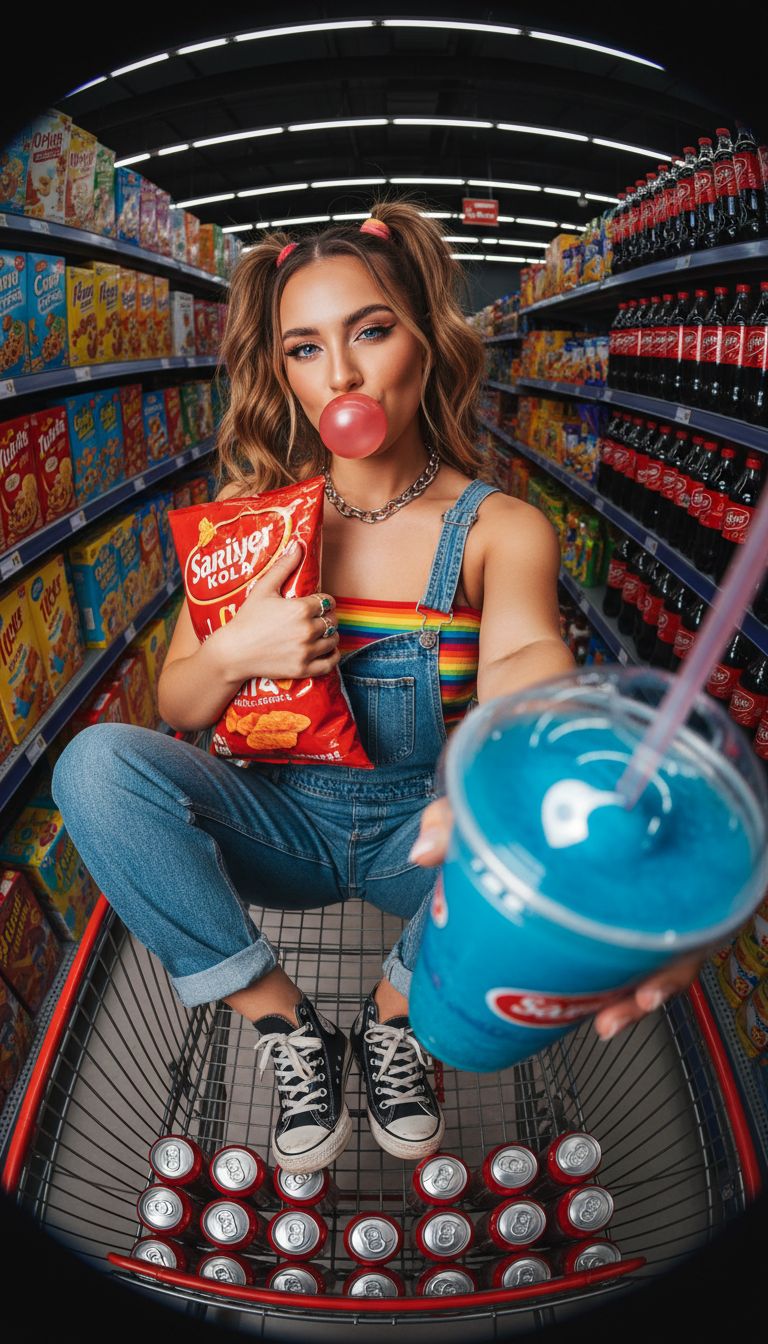
To replicate the high-energy 'Supermarket POV' look seen in successful community creations, designers must master three specific layers of production: the camera physics, the subject's energy, and the environmental detail.
1. Camera Physics: The Fisheye Effect
The hallmark of Y2K-era photography is the wide-angle fisheye lens. In an AI generation context, this is achieved by specifying a 'POV Action Shot' with a 'Fisheye' lens profile. This creates a sense of depth and immersion, pulling the viewer into the scene as if they are part of the action. This technique is particularly effective for ecommerce brands looking to create 'lifestyle' content that feels authentic and unscripted.
2. Subject Dynamics and Character Consistency
Creating a character that feels 'alive' requires specific descriptors. In our featured workflow, the subject is defined by a 'ebellious, cheeky, and energetic' vibe. Key elements for success include: Expression Control: Using terms like 'winking playfully' or 'blowing a pink bubblegum bubble' to drive character personality. Texture Detail: Specifying 'dewy skin' and 'glossy cherry red lips' ensures the AI prioritizes the high-shine textures essential to the Y2K look. Styling:* Detailed makeup instructions (glitter on eyelids, sharp eyeliner) prevent the AI from defaulting to generic facial features.
3. Environmental Depth and Brand Integration
One of the hardest tasks in AI generation is maintaining brand consistency within a chaotic environment. A successful workflow involves defining the background with high specificity to avoid 'visual noise' that distracts from the subject. For example, specifying 'neon-lit supermarket aisles' with 'glossy red accents' creates a cohesive color palette that complements the subject's styling.
From Generation to Production: The Role of the AI Canvas
Generating a great image is only the first step. For professional marketers and ecommerce sellers, the real work begins during the refinement stage. This is where a standard AI generator differs from a true AI creative workspace.
When working with complex scenes—like a supermarket aisle filled with specific product packaging—standard text-to-image tools often struggle with brand-specific details. A production-ready workflow utilizes a canvas-based production design approach. This allows creators to:
Reference-Guided Editing: Using a specific product image as a reference to ensure the AI maintains the correct label and color for a specific brand (e.g., ensuring a cola bottle looks exactly like the brand's real-world counterpart). Layered Control: Treating elements of the image as editable layers rather than a flat file. This allows for the adjustment of lighting or the addition of specific props without regenerating the entire scene. Crop Variants and Aspect Ratios:* Automatically generating different crop variants (9:16 for TikTok/Reels, 1:1 for Instagram) to ensure the composition remains effective across all platforms.
Conclusion: Scaling Creativity for Ecommerce
For founders and creators, the ability to move from a prompt to a production-ready asset is the ultimate competitive advantage. By combining high-energy visual directions like the Y2K POV with a structured canvas workflow, brands can produce a high volume of high-quality, stylistically consistent assets that resonate with modern audiences.
Sources and further reading
The workflow and platform rules in this article are grounded in these primary references. Confirm current rules for your market and channel before publishing.
- Vibart community work: Y2K Supermarket POVVibart community · 2026-01-09
Next step: make one asset with the same workflow
Do not stop at the comparison page. Upload a reference, generate a direction, then keep copy and brand elements editable on the canvas.